Short answer: Most commercial sites are built on fixed bullet and dome cameras, then add specialty cameras only where a standard camera can't do the job: multi-sensor or fisheye cameras for wide open areas, PTZ cameras for live tracking over long distances, license plate recognition cameras at gates, thermal cameras for dark perimeters, starlight cameras where color at night matters, and explosion-proof or corrosion-resistant housings in hazardous or harsh industrial areas. Mobile camera trailers cover job sites and lots with no building to mount on. The right mix depends on what each camera needs to see, not on picking one "best" camera.
Which camera types fit which jobs?
| Camera type | Best use | Limits to know |
|---|---|---|
| Fixed bullet | Fence lines, gates, driveways, long building sides, visible deterrence | Obvious and easy to see where it points; not a good fit for finished interiors |
| Fixed dome | Lobbies, hallways, retail floors, building entrances, areas within reach of people | Less reach than a bullet for long outdoor approaches |
| PTZ (pan, tilt, zoom) | Large lots and yards where someone actively follows a person or vehicle | Only sees where it's pointed; moving parts need more upkeep |
| Multi-sensor / panoramic | Building corners, large lots, intersections of drive lanes, dock areas | Can have a blind spot directly below; overkill for small rooms |
| Fisheye (360°) | Open interiors such as warehouses, retail floors and open offices | Distorted image needs dewarping; less detail at a distance |
| License plate recognition | Gates, entrance and exit lanes, truck docks, garage ramps | Needs a tight, dedicated view; not a general area camera |
| Thermal | Dark perimeters, fence lines, large outdoor areas, detection in full darkness | Generally can't identify a person |
| Low-light / starlight | Lots and entrances with some ambient light where color matters | Still needs some light; falls back to infrared in total darkness |
| Explosion-proof / corrosion-resistant | Hazardous locations, chemical areas, washdown, coastal or corrosive sites | Higher cost; must carry the right rating for the area |
| Mobile camera trailer | Construction sites, temporary events, lots with no power or building | Relies on solar, batteries and cellular service |
Fixed bullet and dome cameras: the workhorses
Fixed cameras do most of the work at almost every business. They point at one area and record it all the time, which makes them reliable and predictable.
Bullet cameras have a long, obvious shape that shows exactly where they're aimed. That makes them a good visible deterrent and a strong choice for long outdoor views like fence lines, back lanes and the side of a building.
Dome cameras sit flush under a ceiling or soffit and are harder to knock out of position. They suit entrances, lobbies, hallways and any spot people can reach. Many outdoor domes are built for impact resistance. A housing rated IK10, the top of the impact scale, is tested to absorb 20 joules of impact.
For outdoor cameras of either shape, an IP66 rating (dust-tight and protected against powerful water jets) is the common standard for exposed mounting.
PTZ cameras: for active tracking, not general coverage
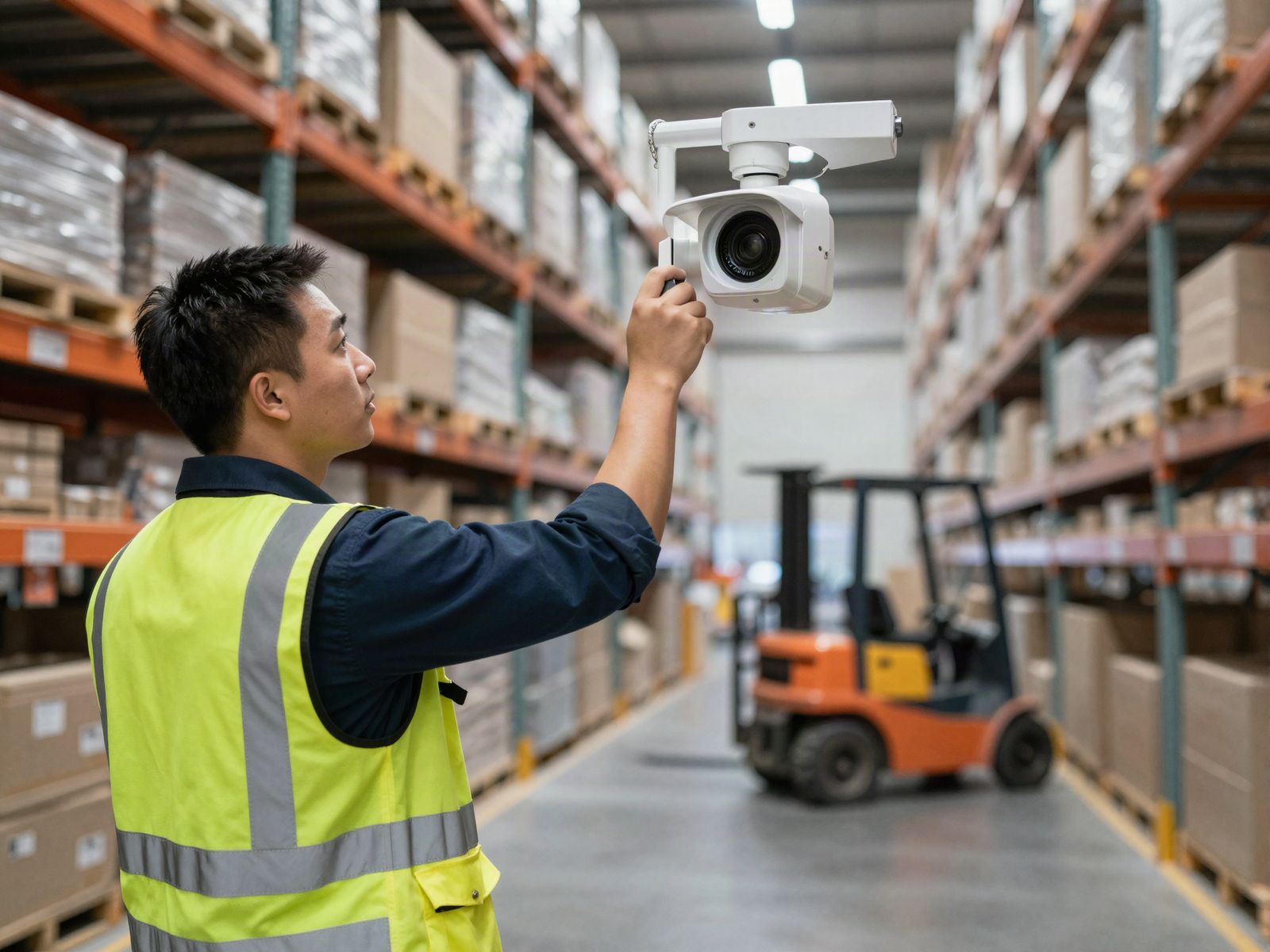
A PTZ camera can pan, tilt and zoom optically, so an operator can follow a vehicle across a large lot or zoom in on a face or plate from a long way off. That's useful when someone is actively watching, such as a monitoring agent working an alert.
The weakness is simple: a PTZ only sees where it's pointed. If it's zoomed in on one corner, the rest of the yard is unwatched. That's why a PTZ works best alongside fixed or multi-sensor cameras that keep the whole area covered. Moving parts also mean more maintenance over the camera's life.
Multi-sensor and fisheye cameras: wide coverage from one mount
Multi-sensor cameras put several image sensors in one housing, each aimed in a different direction, to cover 180 to 360 degrees with good detail. One camera on a building corner can cover two walls and a lot at the same time, which means fewer mounting points and fewer cable runs. Watch the area directly under the camera, which can be a blind spot.
Fisheye cameras use a single wide lens to see a full circle from the ceiling. They're a smart fit for open interiors like warehouse floors and retail space, where one camera can show movement across the whole room. The image is curved and needs to be flattened ("dewarped") by the recording software, and fine detail drops off toward the edges, so they don't replace a fixed camera at a door or register.
License plate recognition cameras
A license plate camera is a specialist. It needs a close, straight-on view of plates in a lane where vehicles slow down, plus its own infrared lighting to read reflective plates at night. It isn't meant to watch a whole lot. If vehicles coming and going matter to your business, see our page on license plate recognition cameras.
Thermal cameras
Thermal cameras detect heat instead of visible light, so they keep working in complete darkness and pick out a person or vehicle against a cold background along a long fence line. The tradeoff is that thermal images generally aren't enough to identify a specific person, so thermal is usually paired with a standard camera. We cover the details in the advantages of thermal imaging cameras for business security.
Low-light and starlight cameras
Most cameras switch to black and white at night and light the scene with built-in infrared. That works, but you lose color: the red truck and the blue truck look the same.
Low-light cameras, often sold as "starlight" models, use more sensitive sensors to keep producing color video in very dim light. They still need some ambient light, like a parking lot pole or a lit sign. In true darkness, they switch to infrared like any other camera. They're a good fit for lots, entrances and storefronts where color details like vehicle and clothing color help after an incident.
Explosion-proof and corrosion-resistant cameras for industrial sites
Some areas of a plant can't use a standard camera at all.
- Hazardous locations. Where flammable gases, vapors or dust can be present, cameras need to be certified for that area classification. In the U.S., that means ratings such as Class I, Division 1 for areas where an explosive atmosphere can be present during normal operation, or Division 2 for areas where it's only expected during an accident or abnormal condition. These cameras typically use heavy stainless steel housings designed so a spark inside can't ignite the surrounding atmosphere. Your facility's hazardous area classification determines what's required, so confirm it with your safety team or engineer before choosing equipment.
- Corrosive or washdown areas. Chemical areas, food processing washdown zones and coastal sites call for stainless or corrosion-resistant housings. NEMA 4X enclosures add corrosion resistance on top of protection against hose-directed water.
- Flooding or submersion risk. IP67 adds protection against temporary submersion, which is rarely needed but worth it in pits and low spots.
Mobile camera trailers
When there's no building, no power and no internet, a mobile camera trailer brings all three. A typical unit uses solar panels to charge onboard batteries, a cellular connection to send video, and a tall mast to get cameras above the site. Trailers fit construction sites, equipment yards, temporary events and lots between projects, and they can be moved as a job progresses. Extended cloudy weather is the main limit on solar power, which is why many units carry battery reserves or backup charging. Paired with live video monitoring, a trailer can do more than record.
How do you choose the right mix?
Start with what each camera has to accomplish: see that someone was there, recognize who it was, read a plate or detect movement in the dark. Then pick the type that does that job at that distance and in that light. Our guide on how many security cameras a business needs walks through planning coverage area by area.
FAQ
What is the most common type of commercial security camera?
Fixed bullet and dome cameras. They cover most entrances, interiors and building perimeters, and specialty cameras are added only where those can't do the job.
Is a PTZ camera better than several fixed cameras?
Not for general coverage. A PTZ only sees where it's pointed at any moment, so it works best as an addition to fixed or multi-sensor cameras, not a replacement.
Can one 360-degree camera replace several cameras?
In an open room or at a building corner, often yes. It won't replace cameras that need close detail, such as at a door, a register or a gate.
Do I need explosion-proof cameras for my plant?
Only in areas classified as hazardous locations. Your facility's area classification decides that, and the camera has to carry a matching certification.
Get the right cameras for each spot
Turner Security designs and installs business security camera systems, including specialty cameras for industrial sites, gates and job sites, for businesses in Nashville, Middle Tennessee, Chattanooga, North Georgia and national accounts. We'll walk your site, tell you where standard cameras will do and where a specialty camera is worth it, and give you a free quote.