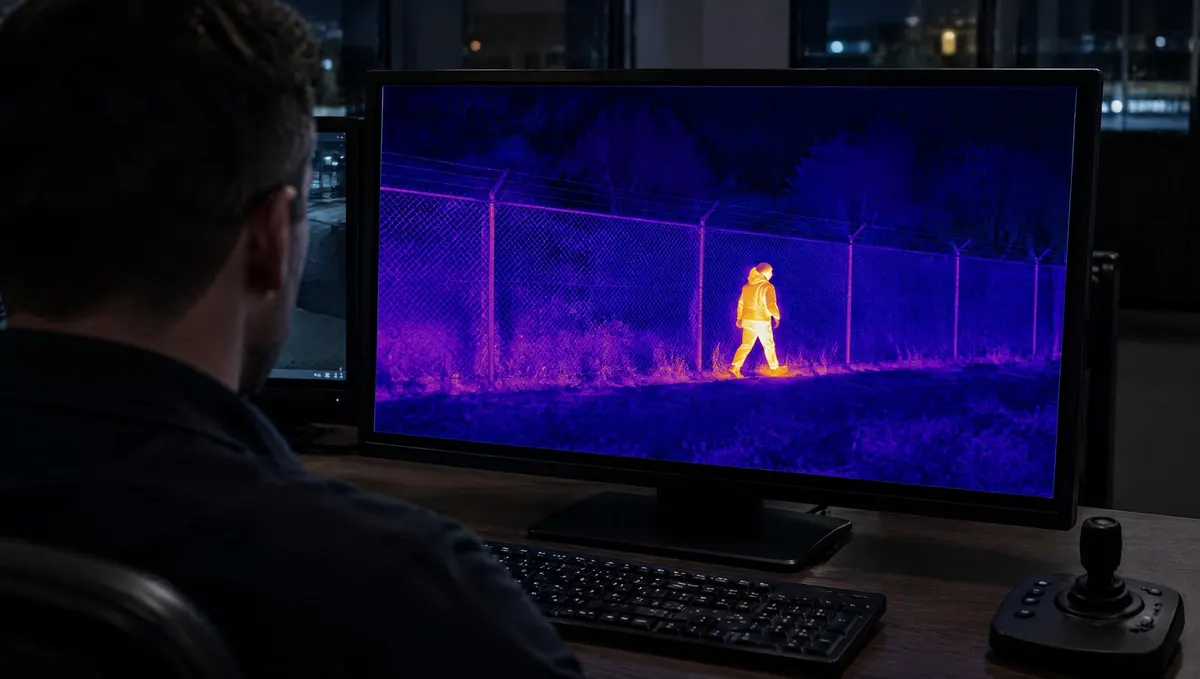
Short answer: Thermal imaging cameras are best at one job: detecting a person or vehicle by body or engine heat across a dark, open area such as a fence line, equipment yard or back lot, where a standard camera would see little or nothing. They are not good at identifying who someone is, because they do not show faces, clothing colors or license plates clearly. On a business property, thermal works best as a detection layer paired with standard cameras placed where identification matters.
How thermal differs from a normal security camera
A standard camera records visible light, and at night it relies on built-in infrared illuminators or site lighting. Its night range is limited by how far that light reaches. A thermal camera does not need light at all. It reads differences in temperature and turns them into an image, so a person standing at the far end of an unlit yard stands out clearly against cooler ground and fencing.
That difference drives everything about where thermal makes sense.
Where thermal earns its cost
Long, dark perimeters
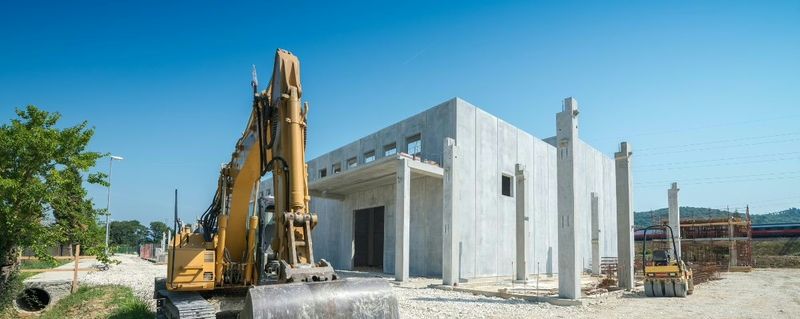
Equipment yards off rural roads in Rutherford or Bradley County, storage lots and utility areas often have long fence lines with no lighting. Covering that with standard cameras means adding lights and more cameras. A thermal camera can watch a long stretch and detect someone crossing it.
Areas where lighting is not practical or not wanted
Some sites cannot add lights because of neighbors, power access or cost. Thermal works in complete darkness.
Smoke, dust and haze
Thermal tends to hold up better than visible-light cameras when the view is obscured by smoke, dust or light fog, which can matter at industrial sites and yards.
Fewer false alerts from shadows and headlights
Because thermal sees heat rather than light, passing headlights and moving shadows do not look like a person. When thermal detection feeds alerts to a monitoring center, that can mean cleaner alerts.
What thermal will not do
- It will not give you a usable face for a police report.
- It will not read a license plate.
- It does not see through walls or most glass, so it cannot watch the inside of a building through a window.
- It shows shapes and heat, which is great for knowing something is there and weaker for knowing exactly what they are doing with their hands.
This is why a thermal-only design is rarely the right answer for a business. You want thermal to tell you someone is at the back fence and a standard camera at the gate or door to show who they are.
A layered layout that works
For a typical yard or lot, a practical design looks like this: thermal cameras along the dark perimeter for detection, standard cameras aimed at gates, doors and drive lanes for identification, and license plate recognition where vehicles enter. Our commercial security camera installation page explains how we choose the camera, lens and mounting spot for each view.
Detection is only half the job. If an alert at 3 a.m. goes to a phone nobody checks, the camera has done its part and nothing else happens. Live video monitoring with talk-down puts a trained agent on that alert, who can speak to the person through an on-site speaker and escalate to police and your contacts. Equipment-heavy businesses such as those on our auto dealers and equipment yards page often combine both.
FAQ
Can thermal cameras identify a person?
Generally, no. Thermal images show heat shapes, not faces or clothing details. Pair thermal with standard cameras at entry points where you need identification.
Are thermal cameras worth it for a small business?
It depends on the property. A storefront with a lit parking lot usually does fine with standard cameras. A property with a long, dark fence line or open yard is where thermal starts to make sense.
Do thermal cameras work in rain and fog?
They usually handle darkness, smoke and light fog better than standard cameras. Heavy rain and dense fog reduce range for any camera, thermal included.
Get a plan for your dark yard or fence line
Turner Security will walk your yard, lot or fence line and show you how camera placement, lighting, AI alerts and live monitoring can cover it. Call our Smyrna office at (615) 223-9600 for Middle Tennessee, or our Chattanooga office at (423) 344-3787 for the Chattanooga area and North Georgia.