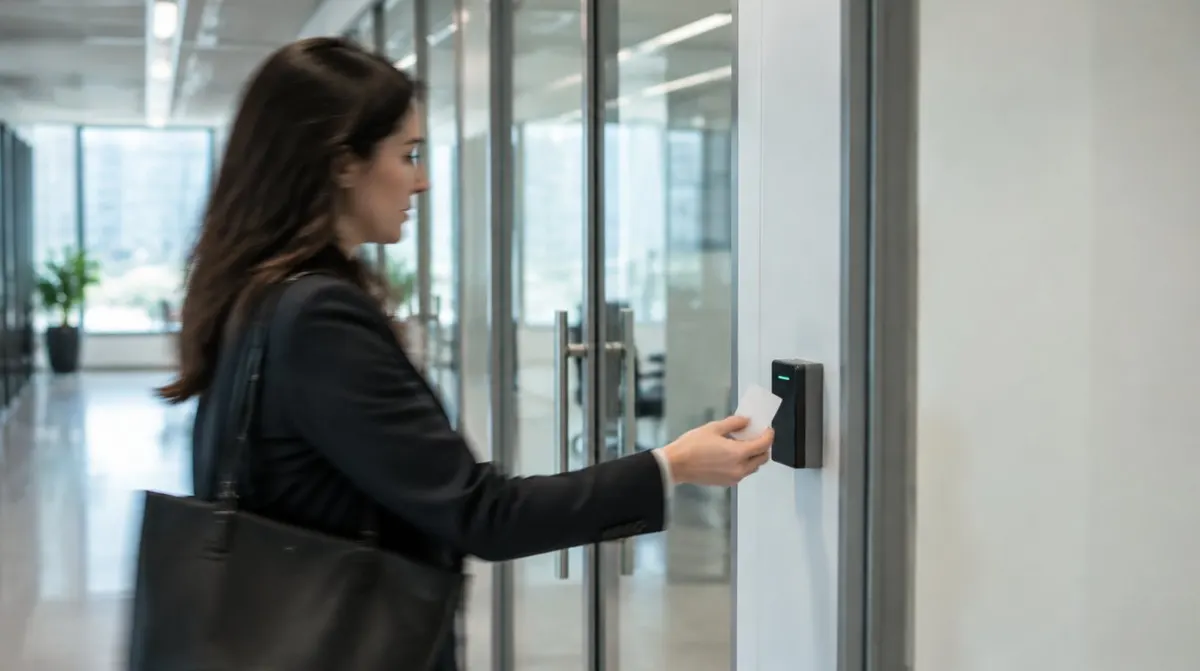
Short answer: Every business with employees, vendors or anything worth protecting needs access control because keys can be copied, never show up in a log and can't be turned off when someone leaves. Here is how it works: a person presents a credential (card, fob, phone or code) to a reader, the reader sends it to a controller that checks whether that person is allowed through that door at that time, and if so the controller releases the lock, usually an electric strike or a magnetic lock, and records the event.
Turner Security has installed and serviced business security since 1976 from offices in Smyrna and Chattanooga. Here is what is inside an access control system and who needs one.
The parts of an access control system
- Credential. What the person carries or knows: a card, a key fob, a phone app or a PIN.
- Reader. The device beside the door that reads the credential. It does not decide anything on its own.
- Controller or panel. The brain, usually mounted in a utility room. It holds the list of who can open which doors and when, and it controls the locks.
- Lock hardware. An electric strike replaces the metal plate in the door frame and releases the latch. A magnetic lock (maglock) holds the door shut with a magnet that lets go when power is cut. The choice depends on the door, the frame and fire code.
- Exit device. A motion sensor or exit button lets people leave without a credential.
- Software. Where users, schedules and reports are managed. With cloud access control, this runs in a browser or phone app, so changes can be made from anywhere.
What happens in a single unlock
- An employee holds a card to the reader at the rear door at 7:52 a.m.
- The reader sends the card number to the controller.
- The controller checks the rules: is this card active, is it allowed on this door, and is 7:52 a.m. on a Tuesday inside its schedule?
- If yes, the controller releases the electric strike for a few seconds and the door opens. If no, the door stays locked and the attempt is logged as denied.
- The event, who, which door and when, is saved and can be reviewed later or sent as an alert.
Safety: free exit and power loss
Fire and life safety codes generally require that people can always get out. That is why exit sensors and buttons, door hardware and fire alarm connections are part of the design, not an afterthought, and why the installer needs to know local code.
Locks are also set up to fail one of two ways when power is lost. Fail-safe locks, like most maglocks, unlock without power. Fail-secure locks, like many electric strikes, stay locked from the outside while still allowing exit. Panels usually have battery backup so the system keeps working through a short outage. Which behavior is right depends on the door.
Who needs access control?
- Businesses with staff turnover. Removing a former employee takes seconds instead of rekeying locks.
- Sites with vendors and contractors. Give them access to one door during set hours, then turn it off when the job is done.
- Anyone with high-value rooms. Server rooms, inventory, cash and records get their own permissions.
- Multi-location businesses. Cloud systems manage every site from one account.
- Businesses that need answers. The log shows who opened a door and when, which helps with investigations and disputes.
Frequently asked questions
Can we keep our existing doors?
Usually. Most doors can be fitted with electric strikes or maglocks without replacement. We check the door and frame on site.
Cards or phones?
Many businesses use both. Phones are convenient and hard to share. Cards are a good backup and work for staff who don't want an app.
Do we have to sign a long-term contract?
No. Turner doesn't lock security customers into multi-year agreements.
Plan your access control
See our commercial access control services, compare access control and keys, or request a free assessment and we'll walk your doors with you.