
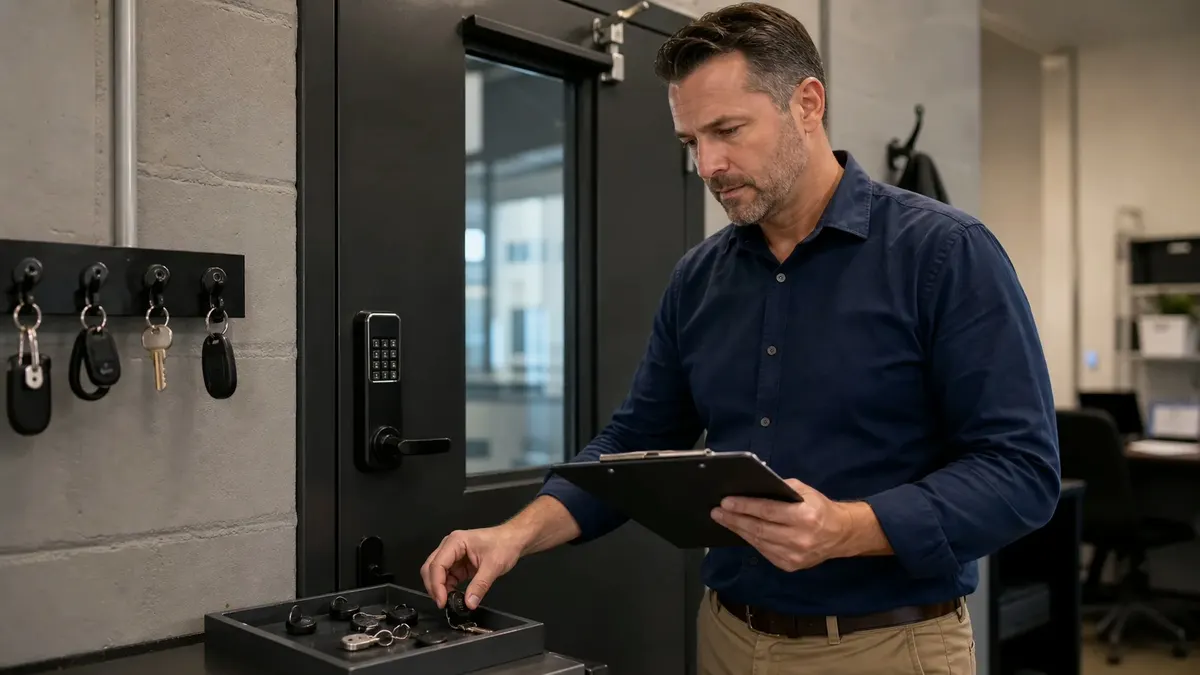
Short answer: Shared keys and PIN codes make it impossible to know who can get into your building or who did. Every key copy and every code that gets passed along stays valid until you rekey or change it for everyone. Individual credentials, where each person gets their own card, fob or phone access, let you turn off one person without disrupting anyone else and give you a record of each entry.
How it usually happens
Nobody decides to run a building on shared codes. It builds up. The owner of a Smyrna machine shop gives the first shift lead a key so he can open at 5:30. The alarm gets one master code at install, and it ends up on a sticky note inside the office door. A cleaning crew in a Chattanooga office gets the back door code. A manager leaves on bad terms and nobody is sure whether he made a copy. Five years later, there are keys and codes out there that nobody can list.
The problem shows up after something goes wrong: inventory walks out over a weekend, a door is found unlocked Monday morning, or the alarm was disarmed at 2 a.m. with the code everyone uses. Now there is no way to tell who it was.
The specific risks
You cannot revoke access for one person
When an employee leaves, a shared code means changing it for everyone and telling everyone the new one, which most businesses put off. A key means rekeying, which costs money and takes a locksmith visit. So the old access stays.
You have no audit trail
A shared alarm code shows the system was disarmed, not by whom. A key leaves no record at all. If you need to answer a question from your insurer, a police report or your own management, you are guessing.
Codes spread further than you think
People share codes with coworkers who forgot theirs, delivery drivers, family members and contractors. Keys get copied at a hardware store, and a "do not duplicate" stamp is easy to ignore.
Time limits do not exist
A vendor who needs in on Tuesday mornings has the same access at midnight on Saturday. A key does not know what time it is.
Step by step: getting off shared access
- Inventory what is out there. List every exterior door, every interior door that protects something valuable, every key you know about and every alarm or keypad code. Ask managers who they gave keys or codes to. Expect gaps.
- Decide which doors matter most. Usually the main entrance, the employee or back door, stockrooms, server or IT closets, cash rooms and records rooms. These are the first doors that get readers.
- Give every person their own credential. Cards, fobs or phone credentials on commercial access control readers. Each one is tied to a name.
- Set schedules by role. Staff get their shift hours. Cleaning crews get their cleaning window. Vendors get the days they actually come.
- Give every alarm user a separate code. Your intrusion alarm should show who armed and disarmed it. Delete the installer default and the old shared code.
- Rekey once, at the end. After readers are on the critical doors, rekey the remaining locks one time and keep keys to a short list of people.
- Make offboarding a checklist item. When someone leaves, their credential and alarm code are turned off that day.
What Turner Security does here
We walk the building with you, look at the doors, hardware and alarm panel you already have, and recommend which doors to put on access control first. We install the readers and set up the system so you can add or remove a person from a phone or computer and see the entry history. After install, our help desk resolves most service issues remotely, and when a technician is needed we can often schedule service the same day you call.
If you are still deciding whether access control is worth it for your building, our guide on access control vs keys lays out the tradeoffs.
Mistakes to avoid
- Swapping one shared PIN for a new shared PIN. It feels like a fix and is not.
- Giving everyone access to every door because the setup is faster.
- Keeping a master key list on paper in the same office it opens.
- Forgetting the alarm codes when you change door access. They are a separate system.
Frequently asked questions
Is a keypad with a different code per person good enough?
It is better than one shared code, and some keypads log which code was used. Codes are still easy to share, though. A card, fob or phone credential is harder to pass along.
Do we need readers on every door?
No. Most businesses start with exterior doors and the few interior rooms that hold cash, inventory, equipment or records. Other doors can stay on keys held by a small number of people.
Can we keep our existing door hardware?
Sometimes. It depends on the doors, frames and locks. We look at each door during the walkthrough and tell you what can stay.
Replace shared access with something you can track
Start with our commercial access control page to see how the system works day to day.
To request a quote, call our Smyrna office at (615) 223-9600 for Nashville and Middle Tennessee, or our Chattanooga office at (423) 344-3787. A rough count of your doors and who holds keys is enough to get started, even if the list has gaps.